

Ah, weeds. The uninvited guests that crash every garden party. If you’re looking for ways to manage these persistent intruders without reaching for harsh synthetic chemicals, you’ve likely heard whispers about a common kitchen staple: vinegar. As of April 15, 2025, the interest in natural, DIY solutions continues to grow, and vinegar often tops the list. But does it really work? And how can you use it effectively?
Vinegar can indeed be a weapon in your weed-fighting arsenal, particularly thanks to its acetic acid content. Think of it as a natural desiccant – it draws the moisture out of the plant cells it touches, causing the foliage to wither and die. It sounds simple, and sometimes it is, but like any tool, it has its strengths, weaknesses, and requires the right technique. Let’s dive into the world of vinegar weed control, exploring various recipes, understanding the pros and cons, and answering those nagging questions.
How Does Vinegar Actually Work on Weeds?
The magic (or rather, the science) is in the acetic acid. When you spray vinegar onto a weed’s leaves, the acid gets to work disrupting the plant’s cell membranes. This causes the cells to leak their contents and lose moisture rapidly, essentially drying the plant out from the top down.
It’s important to understand that vinegar is primarily a contact herbicide. This means it generally only damages the parts of the plant it directly touches – usually the leaves and stems. It’s not typically systemic, meaning it doesn’t travel down to kill the roots of established, perennial weeds like dandelions or thistles in a single application. This is why you might see weeds initially die back, only to resprout from their hardy root systems later. Its effectiveness hinges significantly on the weed type, its age, and the concentration of acetic acid used.
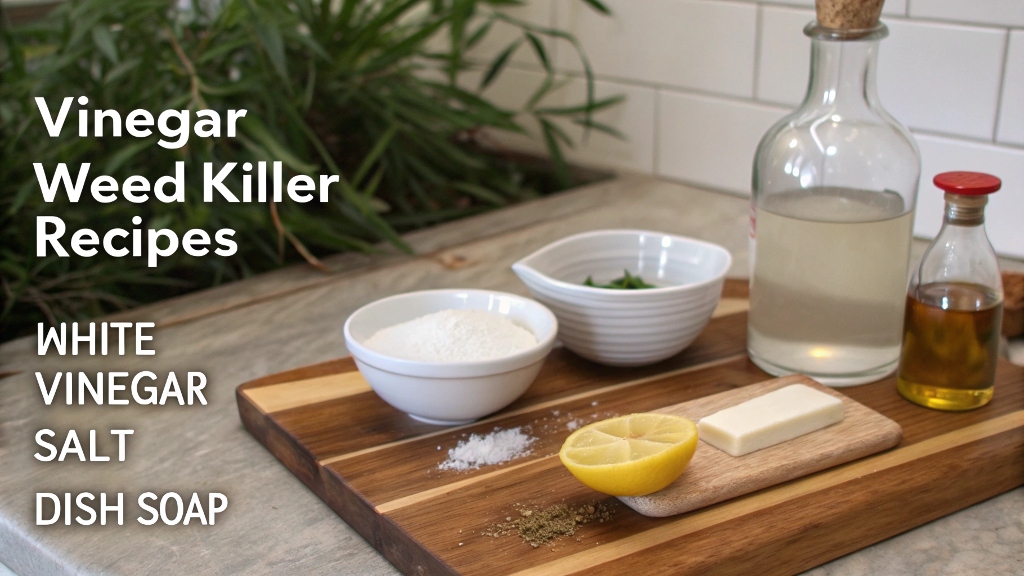
Choosing Your Vinegar Weapon: Household vs. Horticultural
Not all vinegars are created equal when it comes to weed warfare.
- Household White Vinegar: This is the stuff in your pantry, usually containing about 5% acetic acid. It’s readily available, inexpensive, and relatively safe to handle. It can be effective on very young, newly sprouted annual weeds with tender foliage. Think tiny weeds just starting out.
- Horticultural Vinegar: This is a specifically formulated product with much higher concentrations of acetic acid, typically ranging from 10% up to 30% or even higher. Found at garden centers or farm supply stores, this vinegar packs a much stronger punch and is more effective against older, tougher weeds. However, caution is paramount. Acetic acid concentrations above 10-11% are significantly more corrosive and can cause skin burns and serious eye damage. Always wear appropriate personal protective equipment (PPE) – gloves, eye protection, long sleeves, and pants – when handling horticultural vinegar. Follow label instructions diligently.
15 Vinegar Weed Killer Recipes: From Mild to Mighty
Here are various recipes, ranging in potency and application. Remember to always label your spray bottles clearly!
Basic & Mild Recipes (Lower Acetic Acid – Best for Young Weeds):
- Straight Household Vinegar (5%)
- Recipe: Undiluted 5% white vinegar.
- Use: For spot-treating very small, newly emerged annual weeds in garden beds (use carefully around desired plants) or pavement cracks. Simplest approach.
- Household Vinegar (5%) + Dish Soap
- Recipe: 1 gallon 5% white vinegar + 1 tablespoon liquid dish soap (preferably a biodegradable one).
- Use: The soap acts as a surfactant, helping the vinegar cling to weed leaves instead of beading off. Improves effectiveness slightly on young weeds. Good for broadleaf annuals.
- Stronger Household Vinegar (10%)
- Recipe: Undiluted 10% acetic acid vinegar (if available).
- Use: Offers a bit more punch than 5% vinegar for slightly more established young weeds. Use with the same precautions as 5%.
- Stronger Vinegar (10%) + Dish Soap
- Recipe: 1 gallon 10% vinegar + 1 tablespoon liquid dish soap.
- Use: Combines slightly higher acidity with the sticking power of soap for better coverage on young weeds.
Enhanced Acidity & Additives (Use with Caution):
- Vinegar + Lemon Juice
- Recipe: 4 parts white vinegar (5% or 10%) + 1 part lemon juice (fresh or bottled).
- Use: Adds citric acid to the mix, potentially boosting the drying effect on weed foliage. Test on a small area first.
- Vinegar + Lemon Juice + Dish Soap
- Recipe: 1 gallon vinegar (5% or 10%) + 1 cup lemon juice + 1 tablespoon dish soap.
- Use: Combines acetic acid, citric acid, and a surfactant for a slightly stronger DIY mix suitable for young broadleaf weeds.
- Vinegar + Citrus Oil + Dish Soap
- Recipe: 1 gallon vinegar (5% or 10%) + 1 ounce orange oil or d-limonene + 1 tablespoon dish soap.
- Use: Citrus oils contain compounds that can strip waxy coatings off leaves, potentially enhancing vinegar’s effect. Good for broader leaf weeds.
- Vinegar + Essential Oils + Dish Soap
- Recipe: 1 gallon vinegar (5% or 10%) + 10-20 drops clove or cinnamon essential oil + 1 tablespoon liquid Castile soap (or dish soap).
- Use: Certain essential oils have herbicidal properties. This blend adds another layer of action, though effectiveness varies. Best for spot treatment.
Potent Recipes (Higher Acetic Acid & Additives – Use with Extreme Caution & PPE):
- Horticultural Vinegar (20-30%)
- Recipe: Undiluted 20% or 30% acetic acid horticultural vinegar.
- Use: Wear PPE! For tougher annual and young perennial weeds. Effective but non-selective and potentially hazardous to handle. Best for areas away from desired plants, like gravel paths or fence lines.
- Horticultural Vinegar (20-30%) + Dish Soap
- Recipe: 1 gallon 20-30% horticultural vinegar + 1 tablespoon liquid dish soap.
- Use: Wear PPE! Maximizes contact and potency for stubborn weeds. Very effective top-kill, but regrowth from roots is still possible for perennials. Use only where you don’t want plants growing.
- The “Nuclear Option”: Vinegar + Salt + Dish Soap
- Recipe: 1 gallon vinegar (start with 5%, or use 20% for extreme cases – Wear PPE if using 20%!) + 1 cup table salt (sodium chloride) + 1 tablespoon dish soap. Dissolve salt in vinegar before adding soap.
- Use: HIGH SOIL RISK! Salt is a desiccant but persists in the soil, potentially sterilizing it and harming beneficial organisms. Use only for areas where you never want anything to grow again, like deep pavement cracks or under sheds. Avoid near garden beds or lawns.
- Vinegar + Epsom Salt + Dish Soap
- Recipe: 1 gallon vinegar (5% or 10%) + 1-2 cups Epsom salt (magnesium sulfate) + 1 tablespoon dish soap. Dissolve salt well.
- Use: Epsom salt is less damaging to soil long-term than table salt, but also likely less potent as a weed killer. May help dehydrate leaves slightly. A less risky alternative to Recipe #11, but expect less dramatic results.
Application-Specific Recipes:
- Boiling Vinegar (5% or 10%)
- Recipe: Carefully heat household vinegar (do NOT boil horticultural vinegar due to fumes). Pour immediately and carefully onto weeds.
- Use: EXTREME CAUTION! Risk of burns! Combines heat shock with acidity. Very effective for weeds in pavement cracks or gravel areas where runoff isn’t an issue. Keep pets and children far away during application.
- Vinegar Drench for Pavement Cracks
- Recipe: Use a potent mix like Recipe #10 or #11.
- Use: Instead of just spraying leaves, carefully drench the weed and the crack it’s growing in to try and reach more of the upper root system. Best done on a dry, sunny day. Ideal for driveways and sidewalks.
- Targeted Dandelion Treatment
- Recipe: Use horticultural vinegar mix (Recipe #9 or #10). Wear PPE!
- Use: Adjust sprayer nozzle to a stream. Aim directly at the center crown of the dandelion, close to the ground, trying to soak the top of the taproot. Repeat applications will likely be needed as the deep taproot will try to resprout.
How to Apply Vinegar Weed Killer Effectively
- Timing is Key: Apply on a hot, sunny, dry, and calm day. Sunlight and heat accelerate the desiccation process. Avoid windy days to prevent drift onto desirable plants. Rain will wash it off before it can work.
- Target Carefully: Vinegar is non-selective. It will harm or kill any plant it touches, including your lawn, flowers, and vegetables. Use a spray shield (like a piece of cardboard) or adjust your sprayer nozzle to a stream for precise application, especially near desired plants.
- Coat Thoroughly: Ensure you wet the entire surface of the weed’s leaves.
- Safety First: Always wear gloves and eye protection, especially when using horticultural vinegar or mixes with salt or boiling vinegar. Long sleeves and pants are recommended. Keep children and pets away from treated areas until they are completely dry.
- Repeat as Needed: Remember, vinegar often only kills the top growth. Established weeds, especially perennials, will likely require repeat applications every week or two as they attempt to regrow from the roots. Be persistent!
The Upside: Pros of Using Vinegar Weed Killer
Natural Alternative
For those seeking to avoid synthetic herbicides like glyphosate, vinegar offers a more natural approach derived from plant sources (through fermentation).
Relatively Inexpensive
Standard household vinegar is very budget-friendly compared to many commercial herbicides. Horticultural vinegar is more costly but can still be economical for spot treatments.
Breaks Down Quickly
Unlike some persistent chemicals, acetic acid breaks down relatively quickly in the soil (especially without salt additives), reducing long-term environmental impact.
Readily Available
Household vinegar is easily found in any grocery store. Horticultural vinegar is increasingly available at garden centers.
Fast Acting (Top Kill)
You’ll often see weeds wilting and browning within hours or by the next day, providing quick visual results on the foliage.
The Downside: Cons of Using Vinegar Weed Killer
Non-Selective Damage
This is a major drawback. Vinegar doesn’t know the difference between a weed and your prize-winning rose. Accidental overspray can damage or kill any plant.
Limited Root Kill
It’s primarily a contact, top-kill herbicide. It struggles to eliminate the robust root systems of established perennial weeds (dandelions, thistle, bindweed), leading to regrowth.
Concentration Matters (and Hazards)
Low concentrations (5% household vinegar) are often too weak for anything but the youngest weeds. Higher, more effective concentrations (20%+) are hazardous materials requiring careful handling and PPE.
Repeat Applications Needed
Due to the limited root kill, persistence and multiple applications are often required to exhaust the reserves of established weeds.
Potential Soil Impact
While vinegar itself breaks down, additives like salt can severely damage soil health and structure, making it unsuitable for future planting. Even repeated heavy applications of strong vinegar could temporarily lower soil pH in the immediate area.
Can Corrode Equipment
Acetic acid can corrode metal parts in sprayers over time. Rinse sprayers thoroughly with water after use.
People Also Ask: Vinegar Weed Killer FAQs
Q: Is vinegar weed killer safe for pets and children?
A: Household vinegar (5%) is generally considered safe once dried, though it’s best to keep pets and children away during application and until the area is fully dry. Horticultural vinegar (20%+) is much more hazardous; its fumes can be irritating, and contact can cause burns. Keep pets and children far away during application and storage. Always prioritize safety and follow label instructions.
Q: How long does it take for vinegar to kill weeds?
A: You’ll often see wilting and browning within 24 hours, especially with higher concentrations and on sunny days. Horticultural vinegar can show effects within just a couple of hours. However, this is usually just the top growth dying back.
Q: Will vinegar permanently kill weeds?
A: It can permanently kill very young, annual weeds with underdeveloped root systems. For established perennials, it typically only kills the top growth. The roots survive and will likely regrow, requiring repeated applications to eventually exhaust the plant. Adding salt increases killing power but harms the soil.
Q: Does vinegar kill grass?
A: Yes, absolutely. Vinegar is non-selective and will damage or kill lawn grasses just as effectively as broadleaf weeds. Avoid spraying it on your lawn unless you intend to kill that patch of grass.
Q: What concentration of vinegar is best for killing weeds?
A: It depends on the weed. 5% household vinegar might work on tiny seedlings. For most established weeds, horticultural vinegar with 20% to 30% acetic acid is significantly more effective, according to research including studies by the USDA ARS.
Q: Can I use apple cider vinegar instead of white vinegar?
A: Yes, you can use apple cider vinegar (ACV). It typically has a similar acetic acid concentration (around 5%) to white household vinegar. However, it’s usually more expensive and offers no significant advantage for weed killing over plain white vinegar.
Q: Does adding salt make vinegar weed killer better? What about dish soap?
A: Dish soap acts as a surfactant, helping the vinegar stick to leaves, which generally improves effectiveness. Salt acts as an additional desiccant, increasing the mixture’s killing power, but it comes with significant risks to soil health and should only be used very cautiously in areas where soil damage is not a concern (like deep pavement cracks).
Q: When is the best time to apply vinegar weed killer?
A: Apply during the hottest, sunniest part of a dry, calm day. The heat and sun accelerate the vinegar’s action on the plant foliage. Avoid rainy or windy conditions.
Read More Also: Furniture Layout Ideas for Narrow Living Rooms
Conclusion: A Tool, Not a Magic Wand
Vinegar offers a readily available, more natural alternative for managing some weed problems, particularly young annual weeds and those popping up in hardscapes like sidewalks and driveways. Its effectiveness is directly tied to the acetic acid concentration and the type and age of the weed.
While household vinegar provides a low-cost, relatively safe option for the smallest intruders, tougher weeds often require the potency (and associated hazards) of horticultural vinegar. Remember its limitations: it’s non-selective and primarily kills top growth, often requiring persistence and repeat applications for established weeds. Always weigh the pros and cons, use appropriate safety measures (especially with stronger concentrations and additives like salt), and target your application carefully. Vinegar isn’t a replacement for all herbicides or weed management strategies, but it can be a useful tool in your eco-friendlier gardening toolkit when used wisely.