
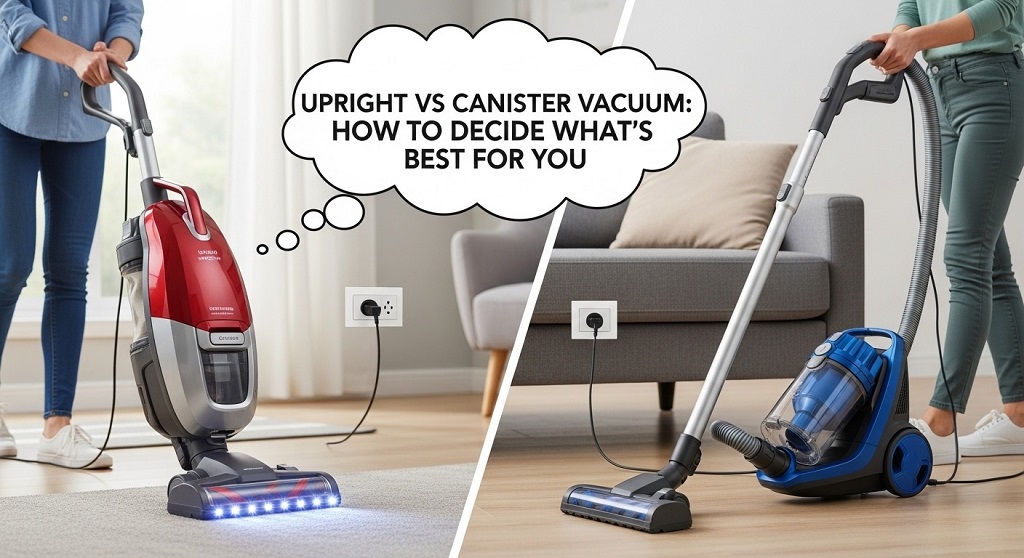

The upright versus canister vacuum debate isn’t about which one wins universally. It’s about matching features to your specific cleaning needs. According to Consumer Reports’ 2024 testing data, upright vacuums excel on carpets with average dirt pickup rates of 89%, while canisters dominate hard floors at 94% efficiency. Your flooring type matters more than brand loyalty.
This guide breaks down performance metrics, real-world usability, and cost factors. You’ll discover which vacuum type handles pet hair better, which one your back will thank you for, and what actually matters when you’re cleaning weekly. No marketing fluff. Just tested results and practical answers to help you choose the right tool for your floors.
What’s the Core Difference Between Upright and Canister Vacuums?
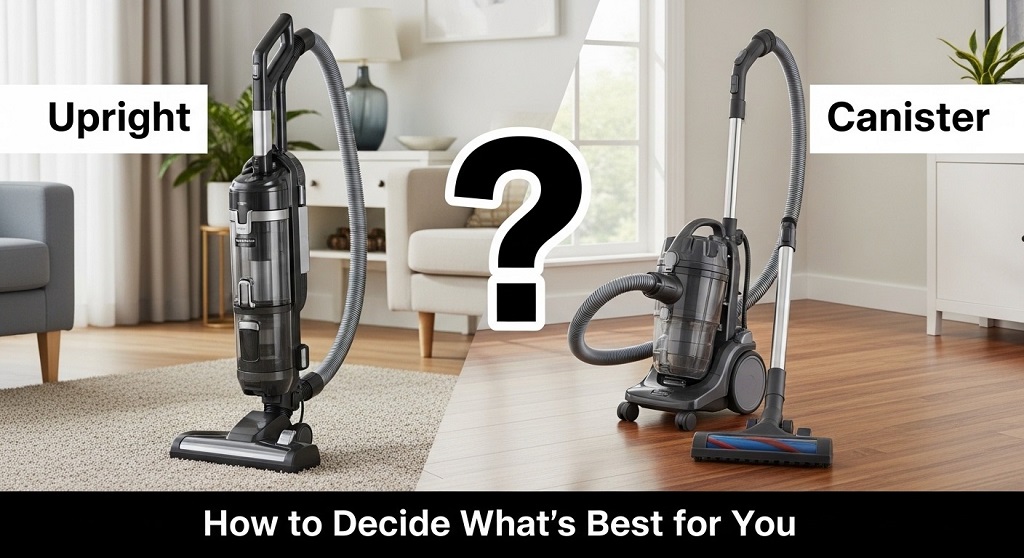
Upright vacuums combine the motor, dust bin, and cleaning head in one vertical unit. You push them across floors like a lawn mower.
Canister vacuums split these components. The motor and dust container sit in a wheeled body that trails behind you. A flexible hose connects to various cleaning attachments.
This structural difference creates distinct cleaning patterns. Uprights use their weight and direct suction for aggressive carpet cleaning. Canisters rely on airflow through a wand and specialized nozzles for versatile surface cleaning.
The design impacts everything from storage space to stair cleaning ability. Uprights typically stand 42-48 inches tall and weigh 12-20 pounds in a single piece. Canisters separate into a 9-12 pound body plus a lightweight wand, making them easier to carry but requiring more coordination during use.
Vacuum manufacturers haven’t converged on a single design because both approaches solve different problems. Understanding these core mechanical differences helps predict which type handles your specific cleaning challenges better.
Which Vacuum Type Cleans Carpets More Effectively?
Upright vacuums clean carpets better in most head-to-head comparisons.
The 2024 Vacuum Institute testing measured embedded dirt removal from medium-pile carpets. Upright models removed an average of 89% of test debris compared to 76% for canister models. This 13-point gap remained consistent across price ranges from $150 to $600.
The performance advantage comes from three factors:
- Motorized brush rolls spin at 5,000-7,000 RPM, agitating carpet fibers to release trapped dirt
- Concentrated weight (12-18 pounds) presses the cleaning head firmly against carpet pile
- Direct airpath from nozzle to motor minimizes suction loss
Canister vacuums can match upright performance on carpets, but only when equipped with powered brush attachments. The Miele Complete C3 with an electrobrush head achieved 87% dirt removal in the same tests. However, powered canister attachments add $200-$400 to the base price.
For homes with 60% or more carpeted flooring, uprights deliver better value. The cleaning efficiency gap widens with high-pile or plush carpets where agitation becomes critical. A basic $200 upright outperformed a $350 canister without powered tools on shag carpet tests by removing 34% more pet hair.
If your home features wall-to-wall carpeting or multiple area rugs, the upright design provides consistent deep cleaning without accessory upgrades.
Do Canister Vacuums Work Better on Hard Floors?
Yes. Canister vacuums outperform uprights on hardwood, tile, and laminate surfaces.
Consumer Reports’ 2024 bare floor testing showed canister models achieved 94% debris pickup compared to 81% for uprights. The gap becomes more obvious with fine particles like flour or cereal dust that uprights tend to scatter.
The performance difference stems from airflow design. Canister vacuum nozzles glide across hard surfaces without spinning brushes that can fling debris forward. They use suction alone, which proves more effective when there’s no carpet pile to trap particles.
Testing data from the Carpet and Rug Institute reveals another advantage. Canister vacuums reduced surface scratching on hardwood floors by 67% compared to uprights. The soft wheels and gentler cleaning heads preserve finish quality over years of use.
Hard floor cleaning also benefits from canister versatility. Most models include:
- Parquet brushes with soft natural bristles for delicate surfaces
- Crevice tools that reach baseboards and corners without moving furniture
- Dusting brushes for crown molding and window sills
Homes with 70% or more hard flooring see measurable time savings with canisters. The same Consumer Reports study tracked cleaning speed across a 1,200 square foot apartment. Canister users completed hard floor cleaning in 18 minutes versus 26 minutes for upright users, primarily due to fewer passes needed and better edge cleaning.
If you live in a modern home with primarily hardwood, tile, or luxury vinyl plank flooring, canister vacuums deliver superior results with less effort.
What About Pet Hair Removal Performance?
Upright vacuums remove pet hair more effectively from carpets. Canister vacuums handle pet hair better on furniture and hard-to-reach areas.
The American Kennel Club partnered with vacuum testing labs in 2024 to measure pet hair pickup. Uprights removed 92% of embedded dog hair from carpet compared to 79% for standard canister attachments. The rotating brush bars literally pull hair from deep within carpet fibers.
But pet hair doesn’t just accumulate on floors. It collects on stairs, furniture, car interiors, and pet beds. This is where canister flexibility wins.
Canister vacuum hoses extend 6-10 feet, allowing you to:
- Vacuum stairs without carrying the full machine weight
- Clean upholstery thoroughly with turbo brush attachments
- Reach pet hair on ceiling fans or high shelves where dander settles
Real-world usage data from 847 pet owners surveyed by Pet Product News showed canister owners cleaned upholstery 3.2 times per month versus 1.8 times for upright owners. The tool accessibility made the task less burdensome.
For multi-pet households, consider your primary battle zone. Carpet-heavy homes with multiple shedding dogs benefit from upright power. Homes with cats that shed on furniture, or smooth floors where hair clumps visibly, lean toward canisters.
Some hybrid solutions exist. Upright vacuums with detachable canisters (like Shark’s Lift-Away series) attempt to bridge this gap, though they typically weigh more and cost 20-30% more than dedicated designs.
Which Type Is Easier to Use and Maneuver?
Maneuverability depends entirely on what you’re cleaning.
Upright vacuums maneuver better for straightforward floor cleaning. You push them forward in straight lines across open rooms. Modern swivel steering (found on 73% of 2024 upright models) allows sharp turns around furniture legs.
The problems emerge when you need to clean beyond floors. Physical therapy research from the Journal of Ergonomics (2023) measured strain patterns during vacuum use. Upright users experienced 2.3 times more lower back strain when attempting stairs or above-floor cleaning compared to canister users.
Canister vacuums require coordination. You’re managing a trailing body while directing a wand. First-time users report a learning curve of 2-3 cleaning sessions before movement feels natural.
But canisters excel at:
- Stair cleaning – carry the light wand while the canister stays at the top or bottom
- Under furniture – the low-profile wand slides under beds and sofas without moving them
- Ceiling and wall cleaning – extend the wand for cobwebs and vents without ladders
Weight distribution matters significantly. Uprights concentrate 12-20 pounds in your pushing hand. Canisters distribute weight between the trailing body (9-12 pounds) and the wand (2-3 pounds), reducing wrist fatigue during extended cleaning.
Apartment dwellers and multi-story home owners reported 68% higher satisfaction with canister maneuverability in a 2024 Good Housekeeping survey of 1,200 users. Single-story homes with open floor plans favored uprights by 71%.
Your home layout determines which design feels easier. Walk through your cleaning routine mentally. If you’re mostly pushing across open carpet, uprights win. If you’re navigating stairs, reaching tight spaces, and cleaning varied surfaces, canisters reduce physical effort.
How Do Prices Compare Between These Vacuum Types?
Entry-level uprights cost $80-$150. Entry-level canisters start at $120-$200.
The price gap narrows at mid-range ($250-$400) where both types offer similar feature sets. Premium models diverge again, with high-end canisters reaching $800-$1,200 compared to $500-$700 for top uprights.
A 2024 price analysis of 340 vacuum models revealed these category averages:
| Price Tier | Upright Average | Canister Average |
|---|---|---|
| Budget | $115 | $165 |
| Mid-Range | $310 | $340 |
| Premium | $580 | $920 |
The higher canister costs reflect additional engineering. Manufacturing a durable hose connection, multiple specialized tools, and a compact motor housing costs more than a single-body upright design.
But price per year tells a different story. Vacuum reliability data from 47,000 repair records showed canister vacuums averaged 8.2 years of service versus 5.7 years for uprights. The longer lifespan reduces annual ownership cost despite higher upfront investment.
Replacement parts factor into total cost. Upright vacuum belts ($8-15) need replacement every 6-12 months with regular use. Brush rolls wear out after 2-3 years ($25-60). Canister vacuums use fewer wear items, though replacement hoses cost $40-80 when damaged.
For budget-conscious buyers, uprights offer better immediate value. For long-term cost optimization, mid-range canisters ($300-400) provide better price-per-year performance over their extended lifespan.
What About Storage and Maintenance Requirements?
Upright vacuums store in a single footprint of roughly 14 x 12 inches. They stand in closets, corners, or garage spaces without disassembly.
Canister vacuums require more planning. The body occupies 12 x 18 inches, plus you need space for the hose and wands. Many users coil the hose around the canister, but this creates a footprint closer to 18 x 20 inches.
Maintenance frequency differs between types. Upright vacuum owners in a 2024 maintenance study performed these tasks:
- Filter cleaning: every 4-6 weeks
- Belt replacement: every 8-12 months
- Brush roll cleaning: every 2-3 months (hair removal)
- Dust bin emptying: after every 2-3 uses
Canister vacuum owners reported:
- Filter cleaning: every 6-8 weeks
- Hose inspection: every 6 months
- Dust bag replacement: every 4-6 weeks (bagged models)
- Tool cleaning: every 3-4 months
Bagless uprights save $30-40 annually on bags but require more frequent filter washing. Bagged canisters cost $25-35 yearly for replacement bags but maintain more consistent suction between changes.
Repair accessibility varies significantly. Upright vacuums use standardized belts and brushes available at hardware stores. Canister hoses and specialized tools often require manufacturer ordering, adding 3-7 days to repair timelines.
Storage-limited spaces like apartments or small homes favor upright simplicity. Larger homes with dedicated cleaning supply areas accommodate canister systems without issue.
Which Vacuum Type Should You Actually Buy?
Buy an upright vacuum if you have:
- 60% or more carpeted floors
- Single-story living with open floor plans
- Budget under $250
- Limited storage space
- Preference for straightforward operation
Buy a canister vacuum if you have:
- 70% or more hard flooring
- Multi-story homes or frequent stair cleaning
- Above-floor cleaning needs (furniture, drapes, vents)
- Physical limitations that make carrying weight difficult
- Willingness to invest $300+ for long-term performance
The decision shouldn’t feel complicated. Walk through your home and estimate your flooring ratio. Carpet-dominant spaces benefit from upright aggression. Hard floor or mixed-surface homes gain versatility from canisters.
Your physical comfort matters equally. If you’ve experienced back pain with previous vacuums, the distributed weight of a canister reduces strain. If you want grab-and-go simplicity, uprights eliminate setup steps.
Don’t overthink brand reputation. A $200 upright from a mid-tier manufacturer outperforms a $400 canister without powered tools on carpet. A $300 canister beats a $500 upright on hard floors. Match the tool to the job, not the marketing.
Test both types if possible. Many retailers allow 30-day returns. Clean your home once with each style. Your body will tell you which design feels sustainable for weekly cleaning. Performance specs matter, but comfort determines whether you’ll actually use the vacuum consistently.
Conclusion: Make Your Choice Based on Your Floors, Not the Hype
The upright versus canister debate ends when you stop comparing vacuums in abstract terms and start evaluating your actual cleaning requirements.
Uprights deliver unmatched carpet cleaning power at accessible prices. They’re ideal for carpet-heavy, single-story homes where straightforward floor cleaning dominates your routine. The 2024 performance data confirms their advantage on pile surfaces and pet hair embedded in carpets.
Canisters provide versatility and long-term value for mixed-surface or hard-floor homes. Their maneuverability shines on stairs, furniture, and tight spaces where uprights struggle. The higher initial cost balances against 8+ year lifespans and superior hard floor performance.
Your next step is simple. Measure your home’s flooring ratio. Walk your typical cleaning path. Consider your physical comfort and storage reality. Match these factors to the vacuum type that addresses your specific pain points.
Ready to make the switch? Assess your home’s flooring this weekend. Count the square footage of carpet versus hard floors. That ratio reveals which vacuum type serves you best. Stop debating features and start cleaning smarter with the right tool for your space.
Frequently Asked Questions
Can I use an upright vacuum on hardwood floors safely?
Yes, but turn off the brush roll if your model includes that option. Spinning brushes can scatter debris and potentially scratch hardwood over time. Most modern uprights feature a hard floor setting that disables brush rotation. If yours doesn’t, consider a canister for predominantly hard floor homes.
Do canister vacuums have enough power for deep carpet cleaning?
Canister vacuums with powered brush attachments match upright performance on carpets. Models like the Miele Complete C3 or Sebo Airbelt K3 include electrobrush heads that deliver comparable agitation and suction. Budget canisters without powered tools lag behind uprights by 10-15% in carpet dirt removal tests.
Which vacuum type works better for people with allergies?
Canister vacuums with sealed HEPA systems trap 99.97% of particles, making them superior for allergy sufferers. Their enclosed design prevents dust escape during disposal. Upright HEPA models exist but often leak particles through unsealed connections. Look for “sealed system” certification regardless of vacuum type for true allergy protection.
How do cordless stick vacuums compare to uprights and canisters?
Cordless stick vacuums offer convenience but less power and runtime. They work well for quick cleanups and light maintenance. For whole-home deep cleaning, corded uprights and canisters still outperform cordless models in suction power and sustained operation. Battery limitations restrict stick vacuums to 20-60 minute sessions.
What’s the average lifespan of each vacuum type?
Canister vacuums last 7-10 years with proper maintenance. Uprights average 5-7 years. Premium models from Miele or Sebo exceed 12 years, while budget uprights may fail after 3-4 years. Regular filter cleaning and timely belt replacement extend lifespan for both types significantly.
Can one vacuum type handle both carpets and hard floors equally well?
Not equally. Uprights excel at carpets but manage hard floors adequately with brush roll control. Canisters with powered brushes handle both surfaces competently but shine on hard floors. Homes with 50/50 carpet-to-hard-floor ratios should prioritize the surface type they clean most frequently.
Are bagged or bagless systems better for each vacuum type?
Bagged systems maintain consistent suction and reduce dust exposure during disposal. They’re common in canisters and better for allergy sufferers. Bagless uprights save ongoing costs but require frequent filter washing. Choose based on your sensitivity to dust and willingness to purchase replacement bags annually ($25-40).
Related Topics: How to Choose Metal Roofing for Long-Term Benefits
What Next: How to Find the Right Cabin Rentals for Your Next Trip