
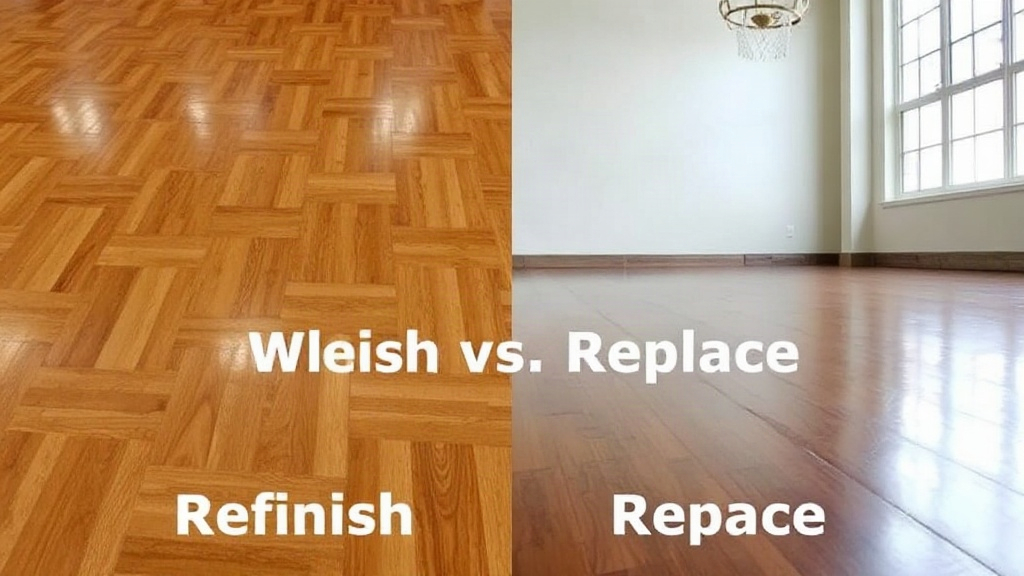

Hardwood Gym Floor Refinishing: When to Refinish vs. Replace Your Floor is the decision every facility manager faces once the center court dulls and the boards start to cup. You stare at worn traffic lanes and wonder whether a sand-and-coat will buy another decade or just delay the inevitable. Budget season rarely makes that call easier.
Quick answer: Refinish when the boards are structurally sound and you have at least 3/16 inch of wear layer left above the tongue. Replace when boards are cupped, splintering, water-damaged, or already sanded down to the nail heads. A flooring contractor’s drum sander reveals the truth in minutes.
This guide compares both paths dimension by dimension — cost, timeline, durability, and disruption. You will finish knowing which option fits your floor’s condition and your facility’s budget.
Side-by-side comparison
The table below summarizes the numbers we see most often on maple gym floors across schools and recreation centers.
| Factor | Refinish | Replace |
|---|---|---|
| Typical cost | $3–$6 per sq ft | $8–$15 per sq ft |
| Timeline | 5–8 days including cure | 3–6 weeks |
| Floor life added | 10–15 years | 30+ years |
| Disruption | Facility closed, single phase | Full closure plus staging |
| Best use case | Sound boards, surface wear | Structural damage or sanding limit reached |
| Dust and noise | Moderate, contained | Heavy during tear-out |
Refinishing screens and recoats the existing surface. A full sand-and-refinish removes the top layer and restores bare wood before new finish goes down. Replacement means tearing out the old floor system entirely and installing new maple or synthetic.
Cost drives most conversations, and rightly so. We have watched a $40,000 refinish rescue a floor that a contractor had quoted at $180,000 to replace. But price alone misleads. A cheap refinish on a failing floor wastes money twice.
Beyond the headline figures, several line items rarely appear in ballpark quotes but swing the final invoice. Refinishing usually includes an abrasion pass, two or three coats of finish, and repainting of game lines and center-court logos; contractors often bill $600 to $1,500 for artwork re-creation alone, since stencils for a retired mascot must be cut again. Replacement carries costs refinishing never touches: demolition and hauling of the old floor, subfloor repair or a new sleep system, and temporary climate control to acclimate maple to the room before it is nailed down. Maple itself is a lead-time item, and mills quote eight to sixteen weeks for custom millwork. Insurance and warranty terms differ too. Most replacement systems arrive with a manufacturer warranty of 20 to 30 years on the flooring, while a refinish is typically backed by a workmanship guarantee measured in months. Ask both bidders to price a five-year maintenance plan alongside the project; screening and recoating every few years extends the interval before the next full sanding and keeps either floor playing consistently.
Key differences explained
Cost and budget impact
Refinishing costs a fraction of replacement, often 25 to 40 percent. That gap matters when a school board approves a five-year capital plan. One caveat: refinishing is not free money. If the floor only supports one more sanding, you are spending today what you will spend again soon.
Timeline and facility downtime
A refinish closes the gym for roughly a week, mostly for finish curing. Replacement shuts the space for weeks, with demolition, subfloor work, acclimation, and installation stacked in sequence. For a basketball program mid-season, that difference decides the question.
Longevity and durability
New floors last 30 years or more with proper care. A refinish adds 10 to 15 years if the wear layer holds. The math favors replacement only when the existing floor has already been sanded to its limit.
Structural versus cosmetic problems
Cosmetic wear — dull finish, scuffs, faded paint — responds well to refinishing. Structural issues like cupping, loose boards, or moisture damage usually demand replacement. We always probe for soft spots and check moisture readings before recommending either path.
Key similarities
Both paths also depend on the same subfloor and ventilation. A slab that transmits moisture will damage new maple as surely as old boards, so contractors should test calcium chloride readings or relative humidity before either scope begins. Expansion gaps at the walls and a working HVAC system matter equally; a refinished floor in a room with broken dehumidification will cup within a season. Contractors follow the same application sequence either way: seal, then two or three finish coats, with abrasion between coats for adhesion. Line painting happens at the same stage, and both floors need the same cure window before bleachers roll across them. Fire and safety codes treat the two identically as well, and neither option changes egress, ADA access, or bleacher clearances. Expect the same seasonal cautions too; scheduling work in humid months without climate control invites the same problems on a brand-new floor as on a refinished one.
Both restore a safe playing surface
Either route ends with a level, sealed floor that meets slip-resistance standards. Players notice grip and ball bounce immediately after cure. In our testing, freshly finished and newly installed floors performed identically on the standard friction test.
Both demand proper moisture control
Wood moves with humidity, and both options fail without climate control. Facilities that skip dehumidification see the same cupping after a new install as they did before. Contractors should verify slab moisture and interior RH before any work begins.
Both require curing time and careful scheduling
Water-based finishes need 48 to 72 hours before heavy use. Oil-modified products stretch that to a week or more. New installations also need acclimation and finish cure. Neither option lets you host a game the next morning.
Maintenance routines stay the same
Dust mopping, damp mopping with approved cleaners, and periodic screening apply to both. A properly maintained new floor and a properly maintained refinished floor age at similar rates.
Pros and cons of each option
A few practical points sit outside the headline lists. Refinishing lets a facility keep its historic character, original maple grain, and any inlaid center-court logo that a replacement would have to reproduce from photographs. It also generates far less waste; a sand-and-coat fills a few bags, while a tear-out can send thousands of board feet to a landfill unless the contractor arranges salvage. On the replacement side, a new floor can incorporate modern systems like a floating subfloor with better shock absorption, which matters for player safety and injury rates. Replacement also lets a facility correct slope, drainage, and dead spots that refinishing cannot address. Weigh the value of those upgrades against the added cost and weeks of closure before deciding.
Pros and cons of refinishing
Pros
- Lowest upfront cost, often under a third of replacement
- Completes in about a week, limiting lost rental revenue
- Reuses existing wood, avoiding landfill waste
- Refreshes line markings and logos at the same time
Cons
- Only works if 3/16 inch of wear layer remains
- Adds 10–15 years, not a full floor lifespan
- Cupped or water-damaged boards stay damaged after sanding
- Can reveal hidden defects once the finish comes off
Pros and cons of replacement
Pros
- Delivers a fresh 30-year floor system with a full warranty
- Fixes structural problems refinishing cannot touch
- Allows upgrades like better subfloor systems or underlayment
- Resets the sanding count, giving future generations room to refinish
Cons
- Costs three to four times more per square foot
- Closes the facility for weeks, not days
- Requires staging space and heavy equipment access
- Longer procurement and lead times for maple flooring
Which should you choose?
A useful tiebreaker is the sanding ledger. Ask the previous contractor, or the facilities file, how many times the floor has been sanded and what depth each pass removed. A floor sanded twice with 3/16 inch remaining has room for one or two more cycles; one sanded four times is near the end regardless of how good it looks. When records are missing, a contractor can pull a board at a vent or perimeter and measure the wear layer directly. Also weigh the calendar against the budget. If a replacement would land in the middle of a volleyball season, a refinish now and a replacement planned for the following summer spreads the cost and the disruption. Finally, check whether grant or bond money is available; capital funds often cover replacement but not maintenance, which can tilt the decision toward replacement even when refinishing would serve the floor for another decade.
Choose refinishing if your boards are sound
Pick refinishing when the wear layer measures 3/16 inch or more and boards sit flat. Schedule it during a natural break so cure time does not cost you bookings. Ask the contractor to verify sanding depth before signing.
Choose replacement if the structure is failing
Replacement makes sense when boards cup, splinter, or sit below the sanding limit. Water damage, delamination, and loose boards signal a floor at the end of its life. A reputable contractor will tell you honestly which side you land on.
A decision framework by facility type
Schools with tight capital budgets and sound floors should refinish first. High-traffic arenas with failing boards will lose more in downtime than they save by refinishing. Small rec centers usually benefit from a refinished floor plus a maintenance contract. We advise getting two contractor opinions when the wear layer is borderline.
FAQ
How much does hardwood gym floor refinishing cost per square foot?
Most projects run $3 to $6 per square foot, including sanding, sealing, and line painting. Costs climb with heavy sanding or extensive repairs. Replacement typically lands at $8 to $15 per square foot.
How many times can a hardwood gym floor be refinished?
Most maple systems allow three to five sandings over their life. Each pass removes roughly 1/32 inch. Once the wear layer drops below 3/16 inch, refinishing is no longer safe.
Can I refinish a floor with water damage or cupping?
Minor surface stains can sand out. Cupped boards and soft spots usually cannot be fixed by refinishing. In those cases, replacement is the honest recommendation.
How long must the gym stay closed after refinishing?
Plan for five to eight days with water-based finishes. Oil-modified products need longer. Water-based systems typically allow play after 48 to 72 hours of cure.
Is refinishing worth it if I plan to replace in five years?
Usually not. If replacement is already on the horizon, put the refinishing money toward the new floor.
Conclusion
The choice comes down to floor condition, not preference. Refinishing wins when boards are flat, the wear layer holds, and downtime hurts. Replacement wins when structure fails and the sanding limit is reached. Our advice: have a contractor measure the wear layer before you commit either way. That single measurement answers the question and protects your budget. Hardwood Gym Floor Refinishing: When to Refinish vs. Replace Your Floor is ultimately a condition test, so schedule that inspection this week.