
You close every window, seal every gap, and settle in for a comfortable evening—yet by morning, your eyes are irritated, your throat feels dry, and the dust on your furniture seems thicker than it was the day before. That contradiction is more common than most homeowners realize. Sealing a house for energy efficiency also traps pollutants inside. Your HVAC system is supposed to solve that problem, but only when it is set up and maintained correctly. Understanding how filtration, airflow, and humidity control work together—and knowing when something as simple as a dirty filter undermines all three—matters more than most people think. Resources like FirstGradeAppliances can help you match the right filter size and type to your specific system before you make a purchase.
Quick Answer
HVAC systems improve indoor air quality through three main mechanisms: filtration that captures airborne particles, ventilation that dilutes indoor pollutants with fresh outdoor air, and humidity control that keeps moisture levels in a range where mold, dust mites, and bacteria struggle to thrive. The system only performs these functions when the filter is correctly sized, changed on schedule, and matched to the blower’s airflow requirements. A clogged or improperly fitted filter reduces effectiveness across all three mechanisms simultaneously.
Key Takeaways
- Filtration, ventilation, and humidity control work as a system—neglecting one weakens the others.
- Filter MERV rating matters, but so does airflow resistance; a filter that is too restrictive can starve the system and reduce overall air quality.
- Humidity outside the 30–50% range creates conditions for mold, dust mites, or respiratory irritation, even when the filter is clean.
- An HVAC system cannot remove gases, odors, or volatile organic compounds through a standard filter—those require activated carbon or dedicated ventilation.
- Regular maintenance (filter changes, coil cleaning, drain pan checks) preserves air quality benefits more reliably than any single upgrade.
What HVAC Systems Actually Do for Indoor Air
A standard HVAC system is not an air purifier. It is a heating, cooling, and air-moving system that, when properly maintained, happens to provide meaningful air quality benefits as a side effect of its normal operation. Understanding this distinction prevents unrealistic expectations.
Three functions directly affect the air you breathe:
- Filtration: The filter captures particles before air enters the blower and coil. This protects equipment and removes some airborne contaminants from circulation.
- Ventilation: A system with a fresh-air intake or an energy recovery ventilator exchanges stale indoor air for outdoor air, diluting pollutants that filtration cannot capture.
- Humidity regulation: The cooling coil removes moisture during air conditioning, while proper equipment sizing and runtime prevent indoor humidity from climbing into the range where biological contaminants multiply.
Each function depends on the others. A perfectly rated filter installed in a system with poor airflow or standing condensate water will not deliver healthy air. The system must operate as a whole.
Filtration: The First Line of Defense
The filter is the most visible and most frequently discussed air quality component, but it is also the most commonly misunderstood. A filter’s job is to trap particles without choking airflow. Those two goals are always in tension,To keep your ventilation running smoothly year-round, check out our guide on seasonal maintenance tips for efficient hvac systems to protect your home air quality.
How MERV Ratings Affect Both Air Quality and System Performance
MERV (Minimum Efficiency Reporting Value) rates a filter’s ability to capture particles between 0.3 and 10 microns. Higher MERV means finer capture, but also higher airflow resistance. Most residential systems are designed for MERV 8 to MERV 11. A MERV 13 filter may capture more particles but can reduce airflow enough to cause the evaporator coil to freeze in summer or the heat exchanger to overheat in winter.
The practical question is not “What is the highest MERV I can buy?” but “What is the highest MERV my system can handle without losing airflow?” A licensed technician can measure static pressure to answer that question. Without that measurement, installing a high-MERV filter is a gamble that can reduce comfort, increase energy use, and shorten equipment life while delivering less real air quality improvement than expected.
Why Filter Fit Matters as Much as Filter Efficiency
A filter that is slightly too small allows air to bypass the filter media entirely. Air takes the path of least resistance—around the edges, through gaps, past the frame. You can hold a brand-new MERV 11 filter in your hand and still have unfiltered air flowing through a gap the width of a credit card.
Measure your filter slot before ordering. Nominal sizes (like 20x20x1) and actual sizes often differ by fractions of an inch. Check the existing filter’s printed dimensions, verify that it fits snugly, and confirm the airflow direction arrow points toward the blower. A correctly sized lower-MERV filter outperforms an oversized high-MERV filter that lets air leak around the edges.
How Often Should You Change an HVAC Filter?
Manufacturer recommendations typically range from 30 to 90 days. But that range assumes average conditions. Real-world factors change the answer:
- Homes with pets may need changes every 30–45 days.
- Homes near construction, wildfires, or heavy pollen may need more frequent changes during those periods.
- A 1-inch fiberglass filter may load faster than a 4-inch pleated filter of the same MERV rating.
- Running the fan continuously (rather than “Auto”) pulls more air through the filter and shortens its useful life.
A filter that looks gray after one month is doing its job. Replace it. Waiting until it looks completely clogged means weeks of reduced airflow and recirculated particles.
Ventilation: Diluting What Filtration Cannot Catch
Filtration captures particles. It does not remove carbon dioxide, formaldehyde, radon, cooking gases, or volatile organic compounds. Those require ventilation—bringing in outdoor air to dilute indoor concentrations.
Older homes leak enough air through gaps and penetrations to provide incidental ventilation. Newer, tighter homes often do not. Without a deliberate fresh-air strategy, indoor pollutant concentrations can rise well above outdoor levels, even with a clean filter and a well-maintained system.
Options for Adding Ventilation to an Existing System
- Energy Recovery Ventilator (ERV): Exchanges stale indoor air for fresh outdoor air while transferring heat and moisture between the two streams. Best for climates with extreme temperature or humidity differences.
- Heat Recovery Ventilator (HRV): Similar to an ERV but transfers heat only, not moisture. Better suited to cold, dry climates.
- Fresh-air duct with damper: A simpler, lower-cost option that introduces outdoor air into the return duct. Less precise control over temperature and humidity impact.
- Bathroom and kitchen exhaust fans: Point-source ventilation that removes moisture, odors, and cooking contaminants at the source. Effective when used consistently, not just occasionally.
Ventilation and filtration are complementary, not interchangeable. A system with excellent filtration but no ventilation still allows gas-phase pollutants to accumulate. A system with ventilation but poor filtration brings in outdoor particles without capturing them.
Humidity Control: The Overlooked Factor
Indoor relative humidity between roughly 30% and 50% discourages mold growth, limits dust mite populations, and reduces irritation of airways and skin. Above 60%, mold and mildew thrive. Below 30%, dry air irritates mucous membranes and increases susceptibility to respiratory infections.
An air conditioner removes moisture as a byproduct of cooling. But it only removes moisture when it runs. An oversized system that cools a home quickly and shuts off may leave humidity elevated because it never runs long enough to condense sufficient water from the air. This is one of the most common—and least recognized—reasons for persistent indoor dampness in otherwise comfortable homes.
Signs Your HVAC System Is Not Managing Humidity Properly
- Windows fog or sweat on the inside during cooling season.
- Closets or bathrooms develop a musty smell even when clean.
- Indoor humidity readings consistently exceed 55% during air conditioning season.
- The air conditioner short-cycles (runs for only a few minutes at a time).
- Condensate drain lines are dry or produce very little water.
If these signs appear, the cause is often equipment sizing, refrigerant charge, or blower speed—not a dirty filter. A technician can diagnose the issue. Portable dehumidifiers can help in the short term but do not fix the underlying system problem.
What Standard HVAC Systems Cannot Do
An HVAC system with a standard filter is not a whole-home air purifier. It does not:
- Remove or neutralize gases, odors, or chemical vapors.
- Kill bacteria or viruses (some UV or bipolar ionization add-ons claim to, but independent evidence of real-world benefit is mixed and often overstated).
- Capture particles smaller than the filter’s rated efficiency.
- Compensate for a dirty filter, a leaking duct system, or standing water in the drain pan.
- Replace source control—removing or sealing the source of a pollutant is always more effective than filtering it out of the air.
Homeowners who need more than particle removal should consider standalone air purifiers with HEPA and activated carbon, dedicated ventilation, or both. HVAC add-ons can supplement these but rarely replace them entirely.
Practical Steps to Get the Most Air Quality from Your HVAC System
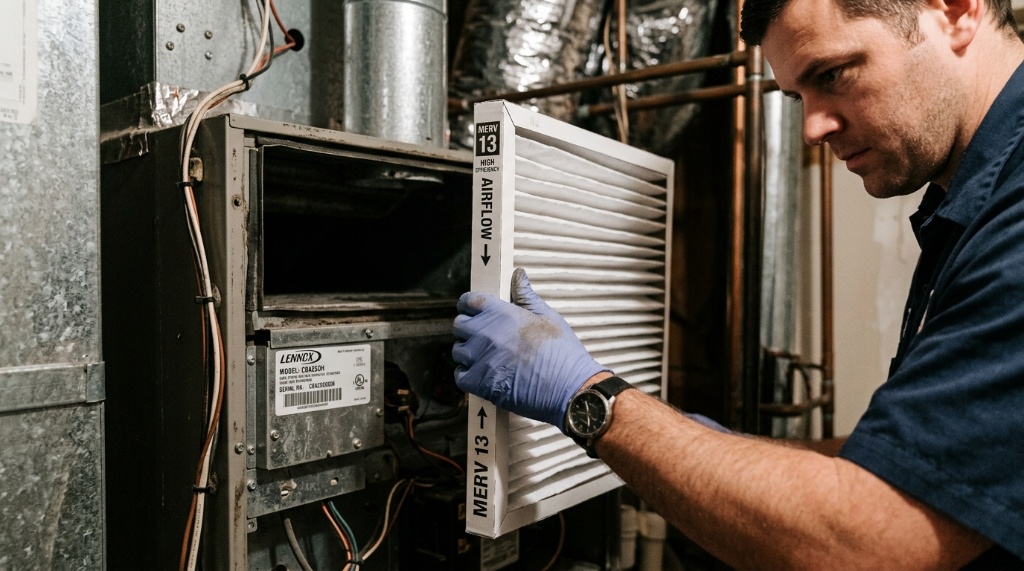
- Verify filter size and fit. Measure the slot. Buy the correct nominal size. Ensure the filter sits flush with no visible gaps.
- Choose the right MERV for your system. MERV 8–11 suits most residential systems. Only increase MERV if a technician confirms your system can handle the added resistance.
- Change the filter on a schedule. Mark the calendar. Do not rely on visual inspection alone—filters can look clean while restricting airflow.
- Keep the condensate drain clear. A clogged drain pan grows mold and introduces biological contaminants into the air stream.
- Schedule annual maintenance. Coil cleaning, blower inspection, and refrigerant charge checks preserve both efficiency and air quality.
- Address ventilation separately. If your home is tight and has no fresh-air strategy, consider an ERV or HRV.
- Monitor humidity. A simple hygrometer costs little and reveals whether your system is managing moisture properly.
- Control sources. Vent the kitchen and bathrooms. Store chemicals outside living space. Fix leaks promptly. No filter can compensate for a persistent indoor pollutant source.
Frequently Asked Questions
Does running the HVAC fan continuously improve air quality?
It increases the number of times per hour that air passes through the filter, which can improve particle removal. But it also increases energy use, shortens filter life, and can introduce more humidity back into the home if the coil is wet. Running the fan on “Auto” is usually more efficient. Running it continuously makes sense during high-pollen periods or when odors need clearing.
Can an HVAC system remove mold from the air?
It can capture mold spores with a filter rated high enough for particles that size. But it cannot remove the moisture source that allows mold to grow. If mold is growing in the ductwork, on the evaporator coil, or in the drain pan, the system is spreading spores rather than removing them. The source must be cleaned and the moisture problem resolved.
Is a higher MERV filter always better?
No. Higher MERV captures finer particles but also restricts airflow more. A filter that chokes airflow can cause frozen coils, overheating, and increased energy consumption. The best filter is the highest MERV your specific system can handle without a measurable drop in performance—typically MERV 8–11 for standard residential equipment.
How do I know if my HVAC system is properly ventilating my home?
If your home was built or remodeled to be very airtight and has no mechanical fresh-air intake, it may be under-ventilated. Signs include persistent odors, stuffy air, condensation on windows in winter, and elevated indoor carbon dioxide. A blower door test or indoor air quality assessment can confirm whether ventilation is adequate.
Can a dirty filter make allergies worse?
Yes. A clogged filter reduces airflow, which can cause the system to short-cycle and distribute less conditioned air. It also allows captured particles to be re-released into the air stream as the filter loads beyond capacity. For allergy sufferers, regular filter changes are one of the simplest and most effective indoor air quality measures available.
Conclusion
HVAC systems contribute to healthy indoor air through filtration, ventilation, and humidity control—but only when all three functions receive attention. The filter is the most accessible starting point: verify the size, choose a MERV rating your system can handle, and change it on schedule. From there, annual maintenance, humidity monitoring, and a deliberate ventilation strategy fill the gaps that filtration alone cannot cover. No single upgrade transforms indoor air quality overnight, but consistent attention to these basics delivers reliable, measurable improvement.