


What Are the Most Common Neighbor Disputes and How Can You Solve Them Legally?
The most common neighbor disputes involve noise, property boundaries, trees, parking, pets, and shared property issues—and most can be resolved legally through documentation, communication, mediation, or local ordinance enforcement before court action becomes necessary.
Few things disrupt daily life faster than tension with the person living next door. A barking dog at midnight. A fence built two feet over the line. A tree branch damaging your roof. These situations escalate quickly when ignored.
Neighbor disputes are among the most reported residential conflicts worldwide. According to housing mediation programs in the United States and United Kingdom, boundary disagreements and noise complaints consistently rank as the top two causes of civil neighborhood complaints each year. The pattern is similar in many urban areas globally.
The real problem is not just inconvenience. Ongoing disputes can reduce property value, increase stress, and even create legal liability if handled incorrectly. Many homeowners wait too long before acting or choose confrontation instead of structured resolution.
This guide explains the most common neighbor disputes and the legal steps you can take to resolve them efficiently, protect your rights, and avoid unnecessary court battles.
What Are the Most Common Types of Neighbor Disputes?
The most common neighbor disputes include noise complaints, boundary disagreements, tree damage, parking conflicts, pet disturbances, shared property issues, and drainage problems.
Residential conflicts typically arise where private property rights overlap with shared living environments. Understanding the category of dispute helps determine the correct legal remedy.
- Noise complaints (music, construction, parties, machinery)
- Boundary line disagreements
- Tree encroachment or falling branches
- Shared driveway conflicts
- Parking obstruction issues
- Pet nuisance complaints
- Water runoff or drainage disputes
- Fence placement disagreements
Each issue falls under a mix of property law, nuisance law, or local municipal regulations. Identifying the correct legal framework early improves your chances of resolving the matter without escalation.
How Can You Legally Resolve a Neighbor Dispute Without Going to Court?
You can resolve most neighbor disputes legally without court by documenting the issue, reviewing local laws, communicating formally, and using mediation services.
Courts are usually considered a last resort. Many municipalities encourage alternative dispute resolution because it saves time, cost, and long-term relationship damage.
Step-by-Step Legal Resolution Strategy
- Document the issue with photos, dates, and written notes
- Review local zoning rules and nuisance ordinances
- Send a polite written request explaining the concern
- Use community mediation services if needed
- Consult a property attorney before escalation
Many disputes end after a written notice referencing local regulations. A structured approach signals seriousness without hostility.
What Should You Do If a Neighbor Is Making Excessive Noise?
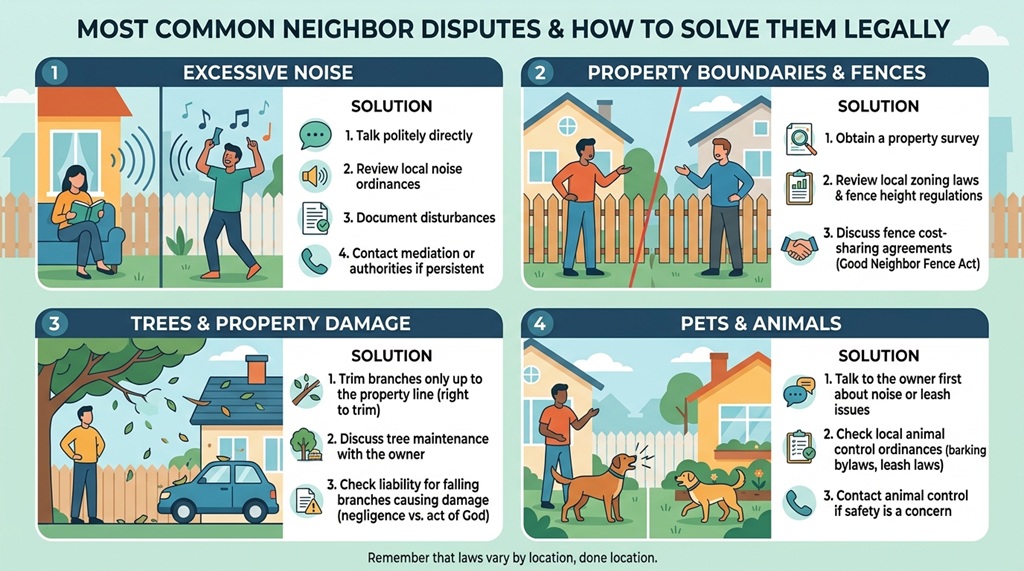
If a neighbor creates excessive noise, check local noise ordinances, document violations, and file a formal complaint with local authorities if the disturbance continues.
Noise disputes are the most frequently reported residential complaints. Cities typically enforce quiet hours between 10 PM and 7 AM, though exact limits vary.
Examples of Legally Actionable Noise
- Loud music late at night
- Continuous barking dogs
- Construction outside permitted hours
- Industrial equipment in residential zones
Keep a log including time, duration, and type of disturbance. Repeated documented violations strengthen enforcement cases.
Can Police Be Called for Noise Complaints?
Yes, police or municipal enforcement officers can respond to noise ordinance violations when disturbances occur during restricted hours.
However, repeated reporting without documentation weakens credibility. Evidence matters.
How Are Property Boundary Disputes Legally Resolved?
Property boundary disputes are resolved using land surveys, title records, and local land registry documentation before legal enforcement or court action.
Boundary conflicts often begin when fences, walls, or landscaping extend beyond legal property lines.
Steps to Resolve Boundary Conflicts
- Review your property deed
- Request a licensed land survey
- Compare registry maps with actual structures
- Send written clarification to the neighbor
- Seek mediation if disagreement continues
A professional survey typically settles most disagreements quickly because it provides legally recognized measurements.
Who Pays for a Boundary Survey?
Usually, the property owner requesting clarification pays for the survey unless a court later reallocates costs.
What Happens If a Neighbor’s Tree Damages Your Property?
If a neighbor’s tree damages your property, the owner may be legally responsible if negligence can be proven or if they ignored prior warnings about risk.
Tree disputes are governed by nuisance law and local vegetation regulations.
Common Tree Dispute Situations
- Branches hanging over roofs
- Roots damaging foundations
- Leaves blocking drainage
- Falling trees causing structural damage
In many jurisdictions, you can trim branches crossing your boundary line, but only up to the property edge.
Can You Cut a Neighbor’s Tree Without Permission?
You can trim overhanging branches on your side of the boundary, but removing the tree entirely without permission is usually illegal.
How Are Parking Disputes Between Neighbors Handled Legally?
Parking disputes are resolved using municipal parking rules, property ownership boundaries, and access-right regulations for shared driveways.
Urban neighborhoods frequently experience conflicts over curb space or blocked entrances.
Typical Parking Conflict Examples
- Blocking driveway entrances
- Using reserved residential parking without permission
- Parking on shared access routes
- Obstructing emergency access
Local traffic enforcement agencies usually handle violations faster than civil courts.
What Legal Rights Do You Have If a Neighbor’s Pet Causes Problems?
If a neighbor’s pet creates noise, damage, or safety risks, local animal control laws allow you to file complaints and request enforcement action.
Pet-related disputes typically involve barking, trespassing animals, or aggressive behavior.
When Can Animal Control Intervene?
- Repeated barking complaints
- Dog bite incidents
- Property damage caused by animals
- Loose pets entering private property
Documentation such as video recordings strengthens enforcement requests.
How Do Shared Driveway Disputes Get Resolved?
Shared driveway disputes are resolved by reviewing property easements, usage agreements, and access rights recorded in land titles.
An easement grants legal permission to use part of another property for access. Violating those terms can trigger enforcement action.
Common Shared Driveway Issues
- Blocking access
- Unauthorized parking
- Maintenance disagreements
- Expansion without permission
Title documents usually define responsibilities clearly. Reviewing them is the first step toward resolution.
What Legal Options Exist If a Neighbor Installs a Fence on Your Property?
If a neighbor installs a fence on your property, you can request removal after confirming the boundary through a licensed survey.
Encroachment cases are handled under property law and may lead to removal orders or compensation claims.
Steps to Handle Fence Encroachment
- Confirm property line with survey
- Notify neighbor in writing
- Request correction within a timeframe
- Seek mediation if unresolved
- Pursue legal enforcement if necessary
Is Mediation Better Than Filing a Lawsuit Against a Neighbor?
Mediation is usually faster, cheaper, and more effective than lawsuits for resolving neighbor disputes.
| Resolution Method | Cost | Time Required | Relationship Impact | Legal Enforceability |
|---|---|---|---|---|
| Mediation | Low | Short | Positive | Moderate |
| Legal Notice | Medium | Moderate | Neutral | Strong |
| Court Action | High | Long | Negative | Very Strong |
Many municipalities operate free or low-cost mediation programs specifically designed for residential conflicts.
When Should You Take a Neighbor Dispute to Court?
You should take a neighbor dispute to court when property damage occurs, legal boundaries are violated, or mediation attempts fail.
Court action becomes necessary when informal resolution methods stop working or when financial loss is involved.
Situations That Justify Legal Action
- Structural property damage
- Repeated ordinance violations
- Encroachment refusal after notice
- Access rights obstruction
- Safety threats
Consulting a property attorney before filing ensures your claim meets legal standards.
Conclusion: What Is the Best Legal Strategy for Handling Neighbor Disputes?
The best legal strategy for resolving neighbor disputes is early documentation, respectful communication, mediation when possible, and court action only when necessary.
Most residential conflicts escalate because people delay structured action or respond emotionally instead of legally. A clear process protects both your rights and your peace of mind.
Start with evidence. Understand local regulations. Communicate clearly. Use mediation services before litigation. These steps resolve the majority of disputes without expensive legal proceedings.
If a conflict continues despite reasonable effort, professional legal advice ensures the next step is effective and enforceable. Acting early reduces stress, prevents property loss, and protects long-term neighborhood stability.
FAQ: Common Legal Questions About Neighbor Disputes
Can I sue my neighbor for harassment?
Yes, you can sue a neighbor for harassment if repeated behavior causes distress, threats, or interference with property use and is supported by documented evidence.
What evidence helps in neighbor dispute cases?
Photos, videos, written logs, survey reports, witness statements, and copies of communication provide strong support in legal disputes.
Do neighbor disputes affect property value?
Yes, ongoing disputes can reduce property value and may need disclosure during real estate transactions in some jurisdictions.
How long does a boundary dispute case take?
Boundary dispute cases typically take several months, depending on survey complexity and court involvement.
Can mediation agreements be legally binding?
Yes, mediation agreements become legally binding when both parties sign written settlement documents recognized by local law.
Is it illegal to record a neighbor causing problems?
Recording visible activity from your own property is generally legal, but audio recording laws vary by jurisdiction and may require consent.
Should you involve a lawyer immediately?
You should involve a lawyer early if property damage, encroachment, or safety risks exist, but minor disputes often resolve without legal representation.
Don’t Miss These Articles: How to Choose Beginner-Friendly Plumbing Tools for Home Repairs
Up Next: How to Choose a Vacuum Cleaner for High Pile Carpets Easily